This website had been down for a while. It was blocked by some safe-surf services, as there was some suspicious code in the PHP files of the blog system, I was using.
Unfortunately, I had no time to deal with this issue earlier, as I'm quite busy with a number of projects. Here is what I did, finally.
Tool: Scribblar – interactive whiteboard
Our classrooms at NUS are equipped with projectors and computers, so we can use Internet tools in class too. In next semester's first seminar, there is a graphic like this.

The task that gave me some headache.
The task is to put in adjectives that describe Geruch (i.e., smell), Geschmack (i.e., taste) or Geräusch (i.e., sound). I could use it with a transparency, but my handwriting is extremely messy, esp. when I use OHP pens. So, I started looking for an on-line solution, and found one. ...continue reading
Thinking, what education is all about
Due to private reasons, I haven't posted something for a while. But I'm back on track now.
At the CLS 10th Anniversary Symposium, Andrew Littlejohn was mentioning McDonaldization of education. For those, who are not familiar with this term, it's coined from George Ritzer's claim of the McDonaldization of the Society. McDonaldization of education means:
[A] process that, if it were taken to its logical conclusion, would transform schools into the instructional equivalent of fast food outlets. Of particular concern is the de-skilling of educators into deliverers of canned programs, the unhealthy standardization of curriculum and pedagogy and the commercialization of public schools. (Leo Casey at Edwize.org)
It seems that this is an issue of the Anglo-American Utilitarian view of education, which is also adopted by the Germans, who had a Humanistic view. The difference is the follows. In the Utilitarian view, the main point of education is getting a degree and training for the job market, while the Humanistic view sees education as (self-)development of the human being. The job market is not focused. Both views are reasonable, however, in their extremes, both are harmful. ...continue reading
Tools for students and educators: Wallwisher
The idea of Wallwisher is quite simple - an online notice board. Notices can be left by the wall's creator or by anyone. The creator can also opt to review other peoples' submission. A Wallwisher wall looks like this.
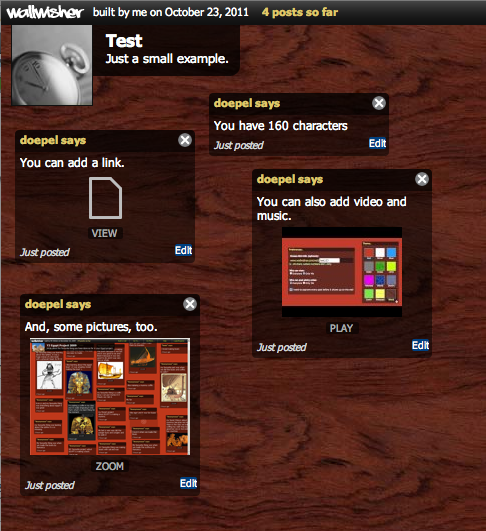
Wallwisher wall, click to enlarge
A notice can consist of up to 160 characters. Web pages, videos or audios can also be linked though. ...continue reading
Tools for educators and students: Voxopop
Voxopop is a tool allowing you to start so-called talkgroups. These groups can be public, restricted or private. Other users can record their contribution. All contributions appear in a stream, if the stream is played, all parts of the conversations played back in a row automatically. So, a talkgroup is like a asynchronous discussion group.
Talkgroup entries can be downloaded as RSS feed, hence podcast. ...continue reading
Criteria for educational tools
Over the last few years, I came across a number of educational tools. Some looked very promising, but revealed some weak points on the second, third, or - when well disguised - fourth look. For me, the following criteria are important when choosing an educational tool. ...continue reading
Tools for students: Audioboo and Soundcloud
Recording your own voice is great to practice pronunciation. By playing it, you can spot errors yourself and you can also send it to a friend / lecturer to get some feedback. There are two web 2.0 services that make recording (even on the go) very convenient. Audioboo and Soundcloud. You can also find some small projects you can do to practice pronunciation, grammar and phrases. ...continue reading
Lesestrategien / reading strategies
Hier eine Spycynode map zum Thema "Lesestrategien". Eine Sache, die ich aber gelernt habe, ist, keine Nodes miteinander zu verbinden, sonst kommt man in einen Teufelskreis.
Here is a Spycynode map about reading strategies. There is one thing, I've learned though: Never link nodes, as this generates a "vicious circle". ...continue reading
Tools for educators and students: twitter
Quite often, I take the second step before the first one. In my last post, I referred to twitter quite often. It seems to be time to discuss it now. In this post, I'll discuss twitter, how it is and why it should be used. And, as usual, I'll discuss possible scenarios for educators and students. ...continue reading
Tools for students: tumblr and posterous
Inhaltsverzeichnis
Why blogging is great.
Writing is a skill that needs to be learned, the more you practice the better you'll become. And that applies to your mother tongue as well as to your foreign language. Blogs also offer the opportunity to reflect about complex issues, resulting in better understanding and the emergence of new ideas. So, blogging is good for your critical thinking abilities.